The Transfer Problem
Motor skills transfer best when the practice content is similar to the performance content. A pianist practicing Chopin does not get much better at Rachmaninoff by practicing Chopin harder. A basketball shooter who only practices free throws does not become great at three-pointers. The specific motor patterns matter.
Typing is the same. Prose typing practice builds motor patterns for letter sequences common in English — 'the', 'and', 'ing', 'tion' — but code typing requires different sequences: `();`, `{}`, `=>`, `!==`, `->`, `::`, `$var`, `&mut`. These sequences are rare or nonexistent in English. Practicing prose does not train them.
The Gap Is Bigger Than Most Developers Realize
A developer who types prose at 75 WPM often drops to 50 WPM on real code — a 25 WPM gap. That gap is not because the developer 'can't type', it is because the specific motor patterns required by code are untrained. Almost all of that gap is recoverable with targeted practice.
The size of the gap also varies by language. Python typists lose 15-20 WPM relative to prose because the language is relatively punctuation-light. Rust typists can lose 25-35 WPM because the symbol density is much higher. Knowing your language's specific gap tells you how much practice time will pay off.
What Actually Transfers
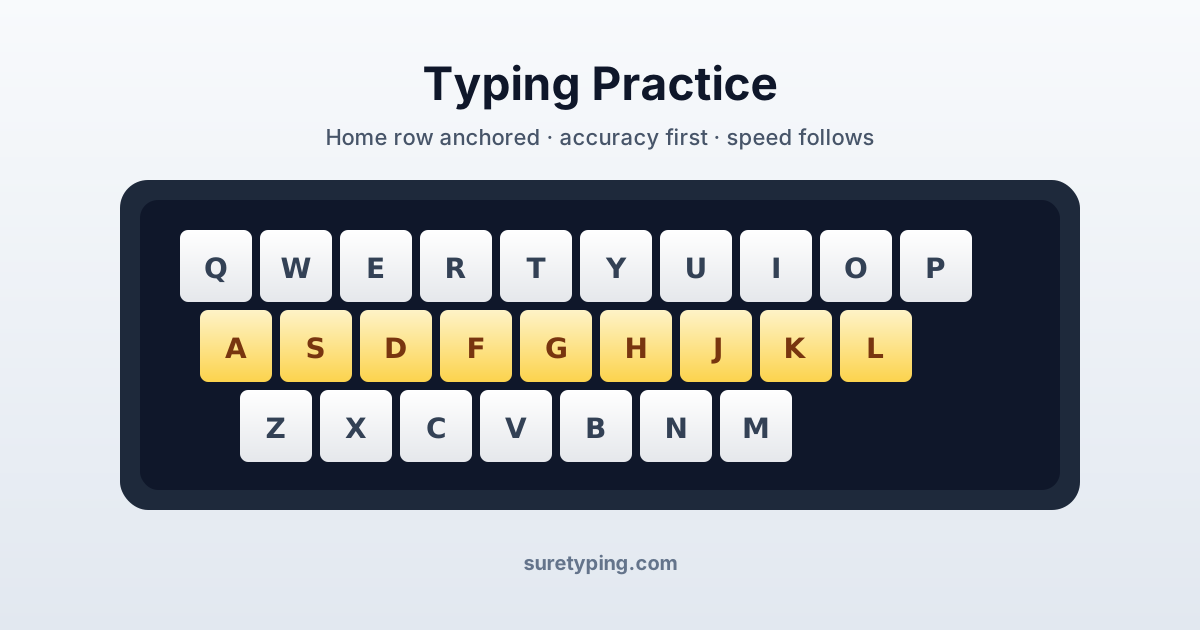
Some things do transfer from prose to code. Home-row anchoring is the same. Overall hand coordination is the same. Comfort with the keyboard as a physical surface is the same. If your prose typing is at 40 WPM because you are still hunt-and-pecking, fix that first — prose practice will help.
But once you are past the hunt-and-peck stage, marginal improvements in prose speed produce almost no marginal improvement in code speed. The patterns are different enough that additional prose practice stops transferring.
Why Code Typing Feels Harder
Beyond the pattern mismatch, code has a second property that makes it harder to type: errors are more expensive. A typo in prose is usually obvious and easy to fix. A typo in code can be a compile error, a runtime exception, or — worst — a subtle bug that compiles fine but does the wrong thing. The consequence is that your brain is more cautious when typing code, which slows you down even when the physical skill is there.
This is why accuracy matters even more for code typing than for prose. The goal is not just 'fewer backspaces' but 'confidence that what you type is what you meant'. Training on real code, with real symbols, at a deliberate pace, is how you build that confidence.
What Code-Specific Practice Looks Like
The SureTyping code typing tracks are built around 16 languages, each with 8 lessons following the same pedagogical arc: symbols, keywords, declarations, control flow, functions, idioms, real snippets, and a mastery sprint. The first three lessons build the motor patterns in isolation. The middle lessons combine them into realistic statements. The last two lessons put everything together in full working code — the kind you actually write at work.
Pick the language you use most and start with the symbols lesson. Two weeks of 15-minute sessions on the right language will close more of the prose-to-code gap than a month of generic typing tests.