Is Switching from QWERTY to Dvorak Worth It?
Dvorak is the more radical reset. It asks for a bigger retraining window, but it also makes the transition feel clean and deliberate.
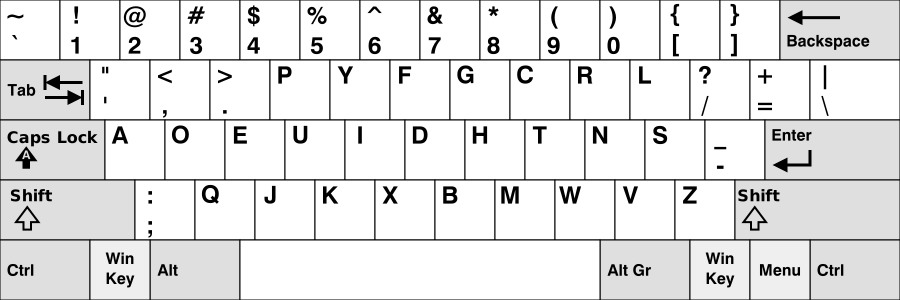
Dvorak makes the most sense when you already type enough each day to notice friction, and you are willing to practice deliberately rather than expecting the new layout to feel natural within a week. If that description fits, the switch is worth considering seriously — and SureTyping's Dvorak layout hub is the right place to start evaluating it with real lessons before you commit.
It is also worth understanding what the research actually says about layout switching. No large-scale study has ever shown that alternative layouts produce dramatically faster typists than QWERTY. The 2023 Aalto University analysis found that practice quality and consistency were far stronger predictors of speed than layout choice. What alternative layouts can offer is reduced finger travel distance and potentially lower fatigue — benefits that matter most to heavy daily typists who are already fast on QWERTY and want a more comfortable long-term path.
- Good fit: people ready to commit to a structured Dvorak practice path over several weeks.
- Bad fit: people who want instant speed gains without accepting a retraining period.
- Best move: attach the switch to a repeatable lesson and review routine from day one.
What Is Dvorak Actually Useful For?
Dvorak is most useful when you want a cleaner break from QWERTY and are willing to build a full personal typing system instead of a half-step migration.
It fits people typing mainly on their own machines, with enough patience to accept setup friction in exchange for a more deliberate non-QWERTY path.
- Best for dedicated personal-machine use rather than shared-device compatibility.
- Best for typists who prefer a full reset over an incremental migration.
- Best when the goal is building one intentional long-term layout and sticking with it.
What Does the QWERTY to Dvorak Transition Feel Like?
The first challenge is accepting a real performance dip while you rebuild movement patterns. Dvorak rewards commitment more than casual experimentation.
The practical goal in the first weeks is not to protect your old WPM. It is to build clean new muscle memory until accuracy becomes predictable again. Speed returns on its own once the layout stops feeling random.
Typists who stick with Dvorak share one habit: they measure progress by accuracy in early sessions, not raw speed. If you are comparing every session to your QWERTY peak, the switch will feel worse than it needs to.
How to Train the Switch to Dvorak on SureTyping
Start from the Dvorak lesson path on SureTyping instead of jumping straight into timed typing tests. The progressive lesson structure keeps the work manageable and makes weak keys easy to spot before they become ingrained problems.
Once your accuracy in a lesson drops or a review session feels unstable, use SureTyping's AI-powered adaptive trainer to drill the exact problem keys rather than repeating the full path blindly. That targeted follow-up is what separates a fast switch from a slow, frustrating one.
- 1. Save Dvorak as your layout in account settings.
- 2. Work through Home-row foundations before moving to timed tests.
- 3. Measure accuracy first — speed will follow once the layout settles.
- 4. Move to customized drilling after weak lessons or unstable review scores.
How Long Before Dvorak Feels Usable?
The honest answer: it depends on how many focused reps you put in each day, and whether you resist the urge to switch back to QWERTY when work gets stressful. Consistent daily practice of 20–30 minutes matters far more than occasional marathon sessions.
Most typists reach rough usability — meaning the new layout no longer feels chaotic — within three to five weeks of consistent daily practice. Speed typically catches up to QWERTY levels within two to four months. If the layout still feels random after six weeks of daily work, the most likely fix is more targeted drilling on the specific keys that are failing, not more overall time.
Research supports this timeline. The 2023 Aalto University analysis of over 136,000 typists found that most people never reach their speed ceiling on any layout — the gap is practice quality, not layout choice. Switching layouts resets the practice clock, but deliberate structured practice closes the gap faster than unstructured daily use.
What to Expect Week by Week When Switching to Dvorak
The first week of the Dvorak switch is almost entirely about finding keys without looking. Speed is irrelevant at this point. Your goal is to type each character with the correct finger, even if that means typing at 5–10 WPM. If you catch yourself looking at the physical keyboard instead of the on-screen preview, that is the habit to break first.
By weeks two and three, the home row keys should start to feel semi-automatic. Common short words begin to emerge as recognizable chunks rather than letter-by-letter searches. Your speed will likely be around 15–25 WPM with intermittent bursts of fluency on familiar patterns. This is the stage where the layout starts to feel like a real skill being learned rather than a frustrating experiment.
Weeks four through six are the consolidation phase. The full keyboard becomes navigable without conscious lookup for most keys, though some positions — typically the less common letters and punctuation — still require deliberate thought. Speed usually reaches 30–50 WPM depending on your QWERTY baseline and practice intensity.
Months two through four are where speed begins to approach or match your previous QWERTY level. The critical factor in this phase is continued structured practice rather than just daily use. Typists who rely on passive daily typing alone tend to plateau earlier than those who continue running targeted drills on their weakest keys using tools like SureTyping's AI adaptive trainer.
What Are the Common Mistakes When Switching to Dvorak?
The most damaging mistake during a Dvorak switch is inconsistent commitment. Bouncing between QWERTY and Dvorak throughout the day creates competing muscle memory patterns that slow both layouts. During the first three to four weeks, pick one layout for your practice sessions and try to minimize casual typing on the other during that window.
The second common mistake is judging the layout by speed too early. Your WPM in the first two weeks is not diagnostic of anything except unfamiliarity. Accuracy developing smoothly across sessions is the correct early signal. If your accuracy is improving even while speed stays low, the switch is working. If accuracy is not improving, the issue is usually unstructured practice rather than a wrong layout choice.
A third mistake specific to layout switching is skipping the structured lesson path and jumping straight to typing tests or real work. Typing tests expose you to the full keyboard immediately, which overwhelms working memory and cements errors before the base patterns are stable. Starting from the home row and building outward — the approach SureTyping's lesson roadmap uses — produces faster consolidation because each layer is stable before the next one is added.
- Do not alternate between QWERTY and the new layout randomly during the first few weeks.
- Do not use WPM as your primary metric until accuracy is consistently above 90%.
- Do not skip the structured lesson path — full-keyboard exposure too early cements errors.
- Do not compare your new-layout speed to your QWERTY peak — the comparison is meaningless during transition.
- Do not practice only when motivation is high — short daily sessions build habits that survive motivation dips.
What usually slows the Dvorak switch down
The biggest Dvorak mistake is treating it like a light experiment. Dvorak works better when you commit to the reset instead of expecting partial familiarity to carry you through.
People often quit too early because the first sessions feel harsh. In reality, those sessions are just the cost of building a new movement system from scratch.
- Avoid judging the switch by the first few days.
- Keep the retraining window deliberate instead of mixing in random unstructured tests.
- Measure progress with stable accuracy and comfort, not only peak WPM.