
Why Typing Speed Matters More Than Candidates Realize
Casper is scored on the substance of your response, not on word count. But substance is heavily constrained by how many words you can actually produce in five minutes while still thinking. A candidate typing at 40 WPM with a 15-second reading pause and a few seconds of thinking can realistically produce around 150 to 170 words in a five-minute window. A candidate at 65 WPM can produce 260 to 300. That extra 100 words is the difference between a sketch of an answer and a fully developed response with reasoning, a counterpoint, and a concrete action.
The effect compounds across a full Casper session. A typing-speed deficit of 20 WPM, sustained over twelve written sections, costs roughly a thousand words of response material across the test. That is a lot of ground to make up on ideas alone.
Target WPM Ranges for the Casper Test
The practical targets below are not official — Altus does not publish them — but they reflect what lets candidates feel unhurried during the written sections.
Below 40 WPM puts you in survival mode. You will spend the full five minutes typing, often without a chance to re-read or refine. At 50 to 55 WPM, you can type a solid response and still have 20 to 30 seconds to check the opening sentence for clarity. At 65 WPM or higher, typing stops being a concern and the only limit is how fast you can think.
- Minimum survivable: 40 WPM at 95% accuracy
- Comfortable target: 55 to 65 WPM at 97% accuracy
- Ideal: 70+ WPM at 97% accuracy, where typing never limits thinking
- Accuracy matters more than peak speed — a backspace costs roughly as much time as typing three characters correctly
Why Accuracy Matters More Than Peak Speed
Raw WPM is the number most people focus on, but for timed written tests accuracy matters almost as much. Every backspace is a round trip: you notice the error, stop, delete, retype. A typist at 80 WPM and 88% accuracy is often slower in effective output than a typist at 60 WPM and 97% accuracy because the faster typist is spending meaningful time in correction loops.
When you practice for Casper specifically, prioritize hitting 97% accuracy first. Once that is automatic, push speed. Reversing that order teaches bad habits that are hard to undo later.
A Four-Week Practice Plan
The plan below assumes you start around 45 WPM and want to reach a comfortable 60 to 65 WPM by test day. Adjust the volume upward if your baseline is lower. Fifteen to twenty minutes per day, six days a week, is enough to produce meaningful gains in four weeks.
Week 1 is about reducing errors on vocabulary. Run the Casper vocabulary warmup and ethical reasoning vocabulary lessons daily. Do not chase speed. Accuracy first.
Week 2 introduces flow. Add reflective transition phrases and first-person response stems. These are the connective tissue of a Casper response — if your fingers already know them, your brain is free to focus on content.
Week 3 is short responses. The short response lessons build up to 75-word full answers typed under light time pressure. Aim to complete each lesson at 55 WPM with 97% accuracy before moving on.
Week 4 is simulation. Run the medium and full response drills, then finish with the exam simulation sprint twice per day. This is where typing speed, vocabulary, and response structure all consolidate.
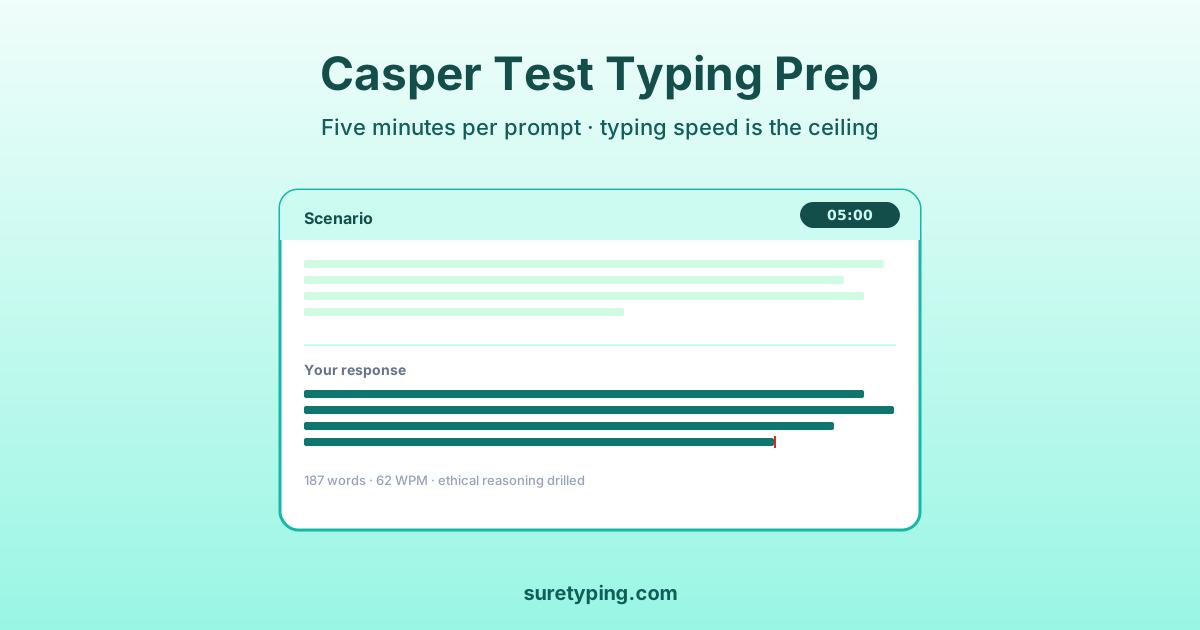
Drills That Specifically Help on Casper
Generic typing tests help, but Casper rewards specific skills that generic tests do not emphasize. The first is vocabulary of reflective writing: words like 'autonomy', 'confidentiality', 'perspective', 'stakeholders', 'responsibility'. These are uncommon in everyday typing practice and feel slow the first time you reach for them under pressure. Drilling them until they are automatic is one of the highest-leverage things you can do.
The second is punctuation flow — semicolons, em-dashes, colons — used naturally inside reflective prose. Casper responses routinely use these, and learners who rarely use them in daily typing slow down noticeably when they appear. The punctuation flow lesson is designed for exactly this.
The third is response-structure fluency. Knowing how you plan to open ('In this situation I would first...'), transition ('On the other hand...'), and close ('Ultimately my priority would be...') removes several seconds of hesitation from every response. Over a 12-prompt session that is a full minute of recovered time.
Common Mistakes That Cost Casper Candidates Time
The biggest mistake is treating Casper typing prep like a generic WPM test. Casper-specific content — ethical vocabulary, reflective phrasing, 75-to-200-word responses — is what actually transfers. Generic prose at random topics builds general fluency but leaves the hardest patterns untrained.
The second mistake is practicing at maximum speed. Speed-focused practice without accuracy discipline ingrains errors and teaches your hands to rely on backspaces. On Casper day, those backspaces are expensive.
The third is skipping the simulation step. If your practice never includes full five-minute responses under realistic time pressure, you will be surprised by how different the real exam feels. Simulation is what closes the gap between lab conditions and test conditions.
What to Do in the Week Before the Test
The week before Casper is not when you build new speed — it is when you consolidate what you already have. Reduce practice volume to 10 to 15 minutes per day, keep accuracy high, and run one full simulation every other day. Do not practice the night before. Motor skills consolidate during rest, and an extra sleep is worth more than an extra 30 minutes of drilling.
On test day, warm up for exactly two minutes with a vocabulary lesson right before the exam window opens. Short warmups prime the fine motor system without tiring it. Then close the practice tab and focus entirely on the test.