
At a glance
| Factor | Casper | Snapshot |
|---|---|---|
| Format | Written responses to scenarios | Recorded video responses |
| Time per response | ~5 minutes | ~2 minutes (plus prep) |
| Typing demand | High — 180-240 words per prompt | Low — no typing unless paired with written follow-ups |
| Prep focus | Reflective vocabulary, transitions, simulation | Verbal delivery, poise on camera |
| Target WPM | 55-65+ for comfort | N/A directly; 45+ for written follow-ups |
| Typical audience | Health-professions, teacher-prep, pharmacy programs | Same programs, as a complement |
What the Altus Suite Is
Altus Suite is the umbrella name for three situational judgement and personal-assessment components: Casper (written + video scenarios), Snapshot (video-only structured interview), and Duet (values-ranking tool). Different programs require different combinations — some ask for Casper only, others require all three.
Each component is independently delivered and independently scored. Preparing well for one does not automatically prepare you for the others, especially on the typing side.
Casper: The Typing-Heavy Component
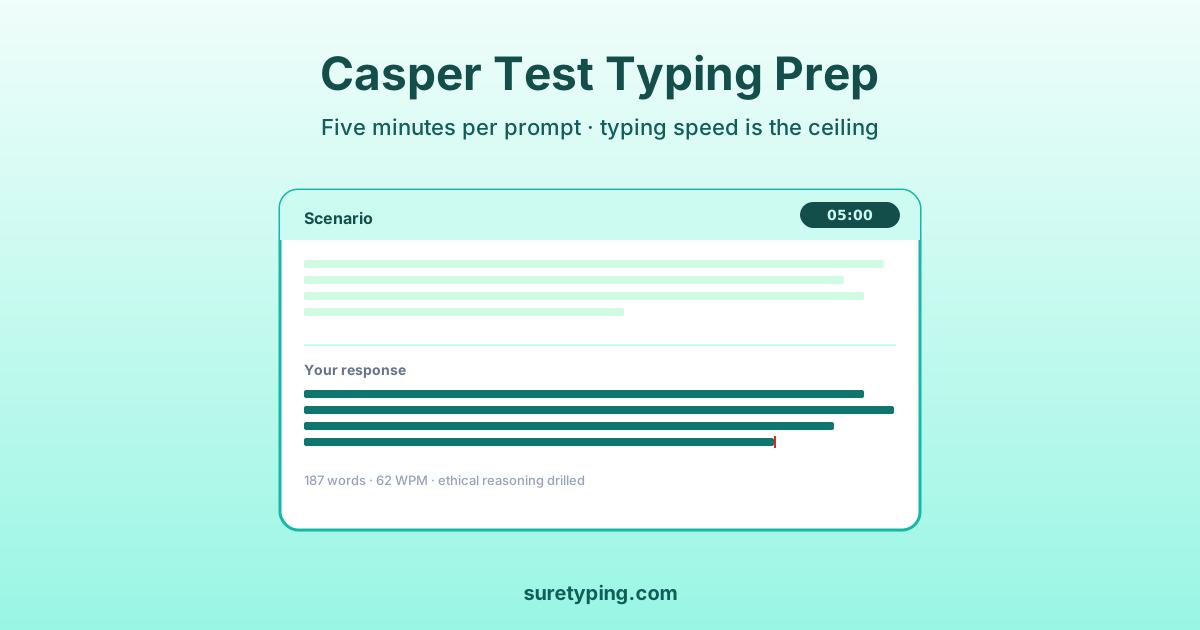
Casper is the component where typing speed matters most. It consists of a series of scenarios, each followed by written or video responses under strict time limits. The written sections give you roughly five minutes per response to type a full answer — no editing after the clock stops, no going back.
Typing preparation is central to Casper. Candidates who can type 55 to 65 WPM on reflective prose finish responses comfortably; candidates under 45 WPM routinely run out of time mid-thought. The Casper Test Typing Prep track is built specifically for this component.
Snapshot: Video Responses With Prep Time
Snapshot is a one-way video interview. You are shown a question, given preparation time, and then recorded answering out loud. There is no typing involved in the core response — the delivery is entirely verbal.
However, many candidates write notes during the preparation window, and some programs pair Snapshot with written follow-up questions. For those cases the Snapshot written follow-up prep track drills tight one- and two-minute reflective paragraphs of the kind that a written supplement might ask for.
Duet: Value-Ranking Plus Written Rationale
Duet asks you to rank a set of values or priorities in the context of a scenario. Some programs also collect a written rationale explaining your ranking, which turns Duet into a partial typing exercise as well. The writing window for the rationale is short — typically one to two minutes per item — so speed and clarity matter.
The Duet typing prep track drills the specific vocabulary of value-ranking rationales ('I prioritized X because...', 'The strongest reason for placing Y above Z is...') and the 110-to-180-word response ranges that fit the typical Duet rationale window.
How Typing Prep Differs Between the Three
Casper prep is about producing 180 to 240 words of reflective prose per five-minute window, reliably, with a clear structure and enough time to re-read. The emphasis is on vocabulary of reflection, transition phrases, and full response simulation.
Snapshot prep is about fluency on video, not typing — but if your program adds written follow-ups, tight 60-to-120-word paragraphs are the target. The drills are shorter and denser.
Duet prep is specifically about justification phrasing. The vocabulary is different (values, trade-offs, rationale) and the response length sits between Snapshot and Casper. If you are preparing for all three, drill them in order of typing demand: Casper first, Duet second, Snapshot written follow-ups last.